Like a Steering Committee for data: Data Governance in a nutshell
I recently saw an article about how Data Governance had grown so large and convoluted that it was essentially irrelevant now and should just be left to die.
I don’t particularly agree with the article, but I acknowledge that Data Governance has become a bit of a catch-all concept, that is hard to grasp for the uninitiated. It got me thinking about how I usually introduce people to Data Governance and how I articulate the link between Data Governance and Data Management
A warning for the purists out there. This is not quite in line with how the DMBoK spells out Data Governance, and for everyone fluent in the EU DGA, it might be a bit superficial. However, one thing is theory, another is real life, and this tends to work for me.
Consider for a moment a project. It can be an IT-project, or whatever you prefer. In a project there is a project team, led by a project manager, and a Steering Committee (Stc.) with representatives from the customer- and the delivery organization. In this situation you have project management (the team) vs. project governance (the Stc.).
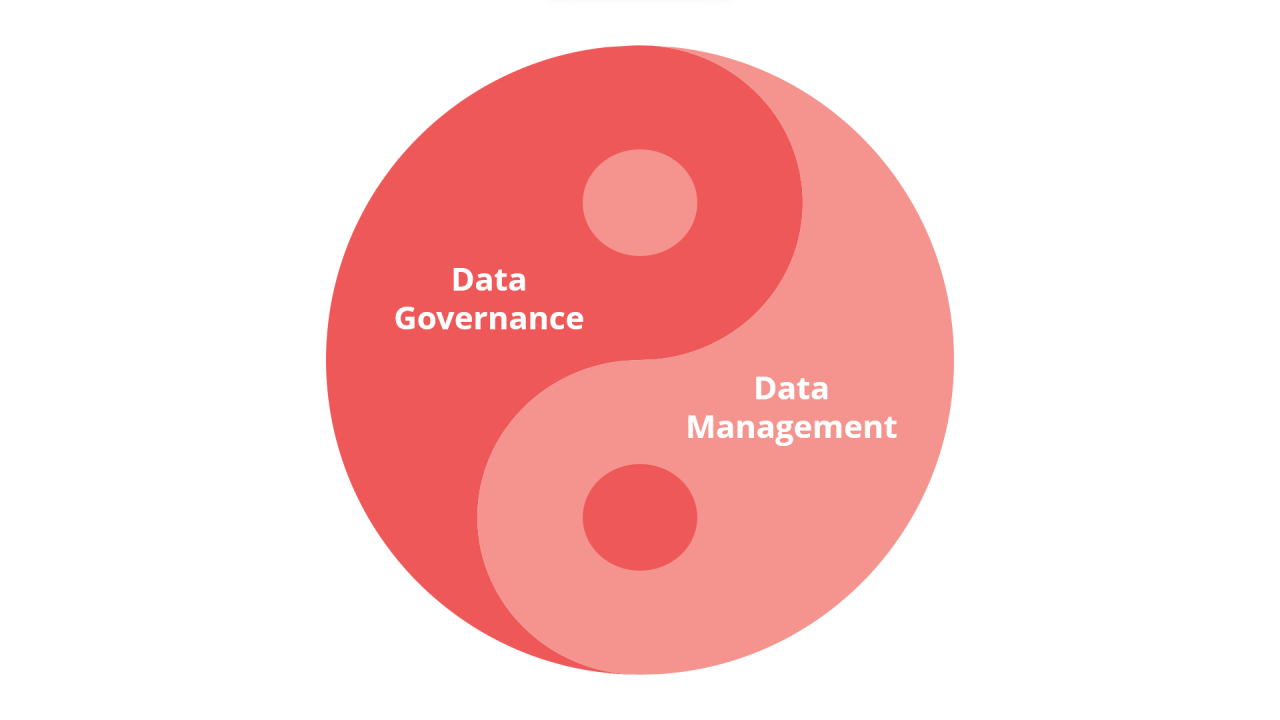
Similarly, in the data world, Data Management covers the different operational and tactical activities that cover the improvement and alignment of data, whereas Data Governance is the act of setting the strategic direction for where this work should go.
This leads to a couple of logical conclusions:
Business involvement: Just like you would never have a project steering committee without deep involvement from the customer organization, data governance does not make sense without business commitment and engagement. Trying to use a delivery resource such as a Data Engineer or Product Owner as a proxy for the customer on this level rarely works.
Hands-off approach: In a project, the team typically does the heavy lifting, and the Stc. weighs in on decisions and direction. This is similar to the approach taken with Data Governance: If you want senior stakeholders and decision makers to participate in data governance, they need to be serviced by facilitators in the Data Management team.
Make pain points relevant: If you have managed to get the attention of senior stakeholders, it is imperative that the proposals and scenarios they receive are sharp, and linked to the business challenges and benefits. Make it tangible and relevant, and if possible, put numbers on what they can expect from it.
Secure alignment: A central part of any project steering committee is to bring up and align disputes across the organization, to pave the way for a successful project. This is also the reason why Data Governance is necessary for Data Management to succeed. Without alignment and governance, even the best Data Management initiative is going to run into differing opinions and standards, leading to failure.
There are of course many additional facets to Data Governance, and one key thing to note (especially when trying to onboard business stakeholders) is that as opposed to a project, Data Governance never really ends.
However, the most reassuring thing I can say to a senior stakeholder that I am trying to get engaged with Data Governance are these nine words: “Think of it as a Steering Committee for data”.
Are you struggling with telling the story of Data Governance in a way that people will listen to? Reach out and book a free 30-minute data call, to get sparring on how to break through.